
Aurora could take a request and place calls in the background, but users still needed to know what the system understood, what was happening, and why a result deserved action.
Agentic AI / Trust / Delegation
Aurora AI: Delegation You Can Inspect
Delegating a call was easy. Trusting what happened was not.
- Product
- AI agent for real-world calls
- Role
- Founding product designer candidate
- Scope
- Product thesis, interaction model, live status, ranked results, edge cases

The tension
The moment a user leaves the app, the agent becomes invisible. That is where trust starts to break.
The waiting state was not dead time. It was the product surface where Aurora could expose progress, learn one useful preference, and earn permission to finish offscreen.
Success looked like
Users can confirm intent once, leave safely, return to ranked choices, and open the exact call evidence behind each recommendation.
The constraint
Calls have uncertain pickup rates, estimates can move, facts may be incomplete, and mid-run changes can invalidate work.
6-10min. expected range
Prototype benchmark, recalibrated as businesses answer.
5stages ask to action
Designed flow: ask, confirm, call, rank, and act.
100%ranked results
Validation target, not a shipped outcome.
The product story
The interface, one decision at a time.
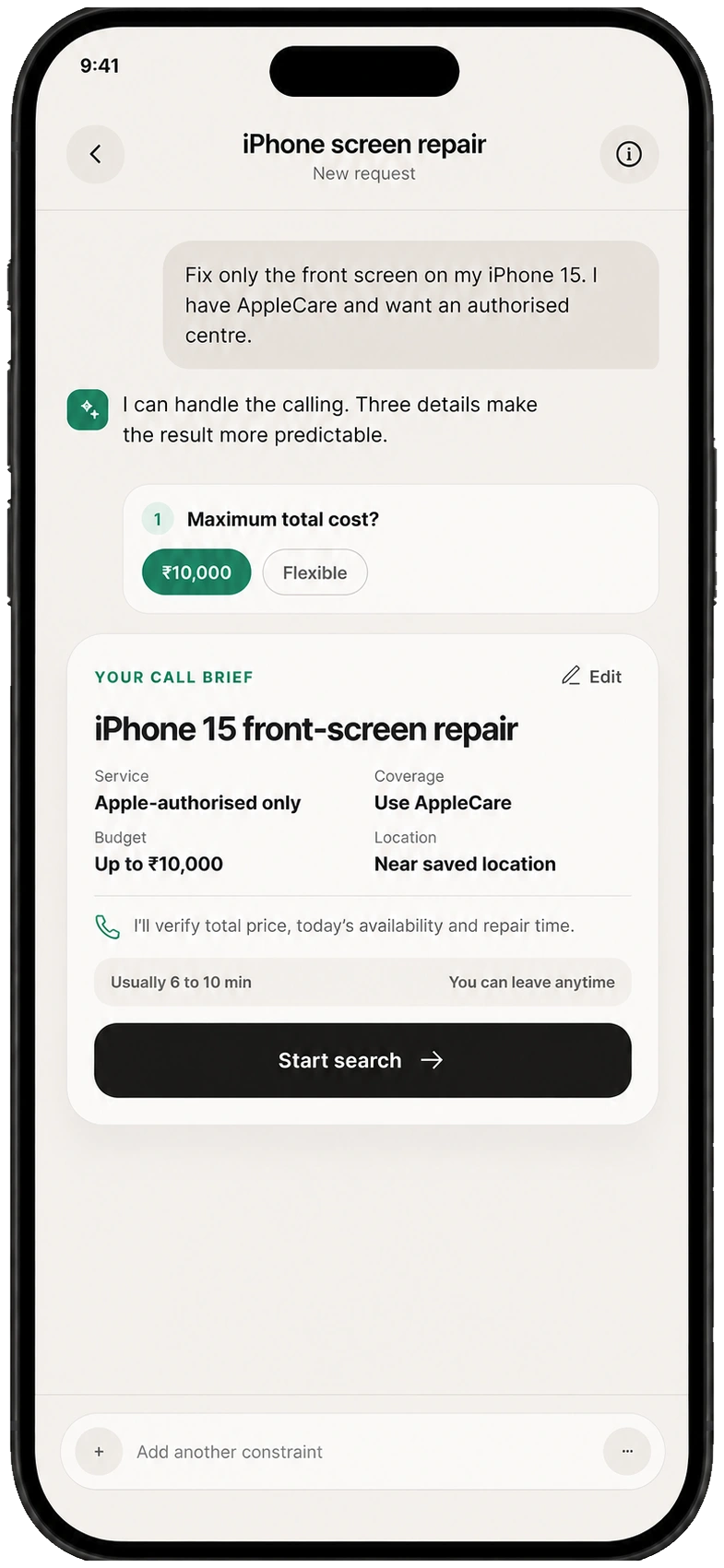
01 / Intent
Teach specificity while confirming the delegation contract.
Aurora turns a loose request into a visible brief, asking only for the constraint that can change the result.
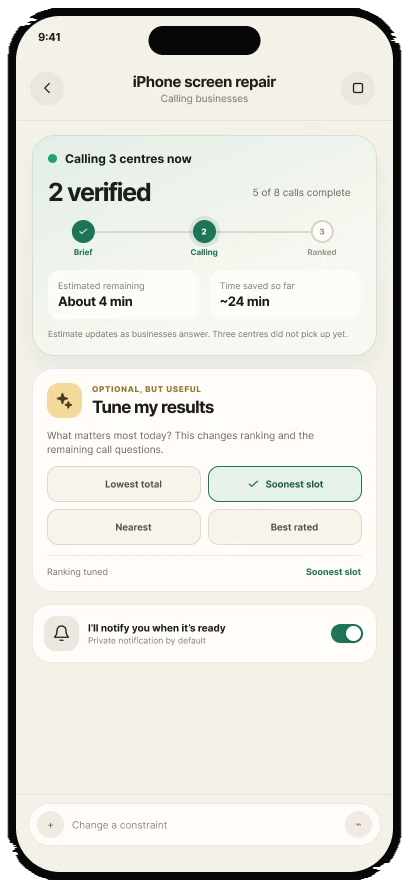
02 / Live run
Make the wait useful, honest, and safe to leave.
A live run shows completed calls, the remaining range, and what changed. One optional preference question improves ranking without blocking the task.
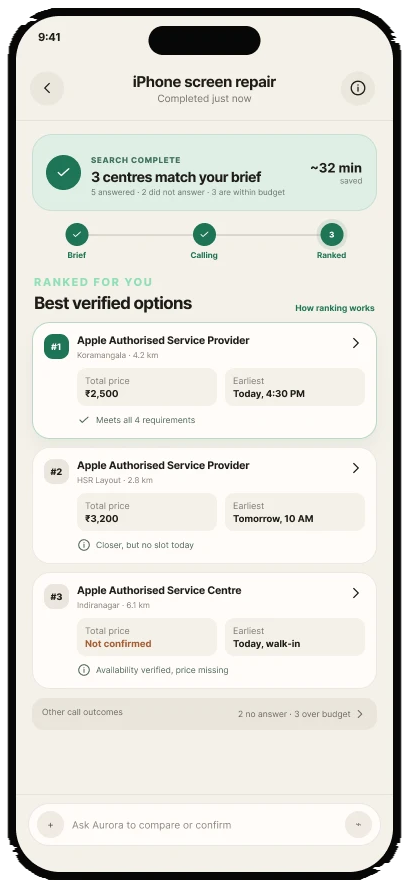
03 / Ranked result
Compress calls into a decision without hiding uncertainty.
Verified options are ranked against the brief, while no-answer, over-budget, and missing-price outcomes remain visible.
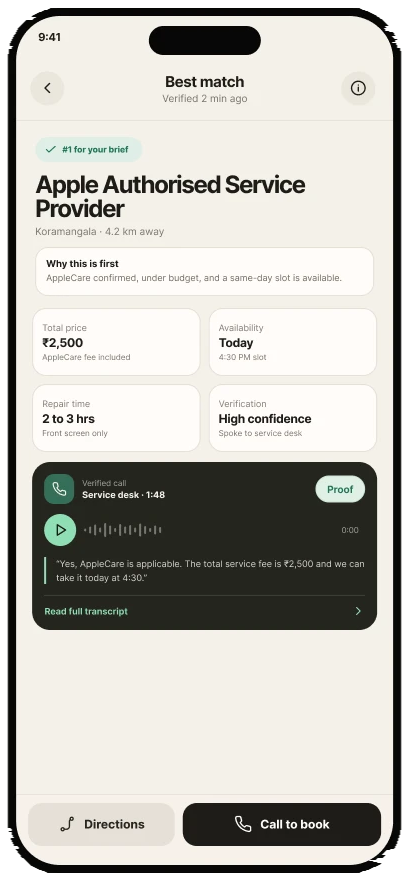
04 / Proof
Put the evidence beside the recommendation.
Structured facts, a recording, and a transcript let the user audit the call before booking or getting directions.
05 / Edge case
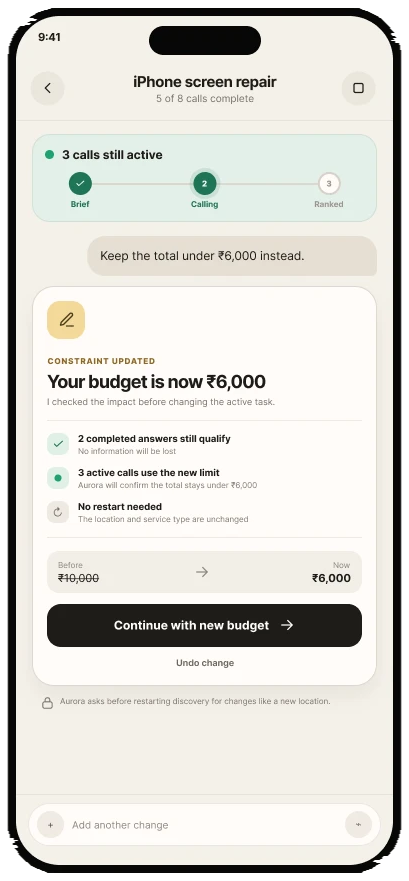
A changed constraint should not silently waste completed work.
When the budget changes mid-run, Aurora explains which answers still qualify, which calls adapt, and whether a restart is needed.
The trust test
The happy path is only half the product.
Businesses do not answer
The run distinguishes no answer from failure, recalibrates the estimate, and keeps verified progress intact.
Evidence is incomplete
Missing price or availability is labelled as not confirmed instead of being filled by model confidence.
The brief changes mid-run
Aurora explains the impact, reuses valid work, and asks before any change that would require a restart.
The decisions
Three moves carried the story.
Teach the brief progressively
Aurora asks for one decision-changing constraint at a time, then shows the complete call brief so better instructions feel useful, not like prompt homework.
Make waiting useful and honest
A time range, live receipts, and recalibration replace fake precision. Optional preference tuning learns what matters without holding completion hostage.
Rank with proof, not confidence theatre
Results explain why they rank, preserve incomplete outcomes, and place recordings and transcripts beside the facts they support.
What I would test next